Wednesday, April 6, 2016

One out of one

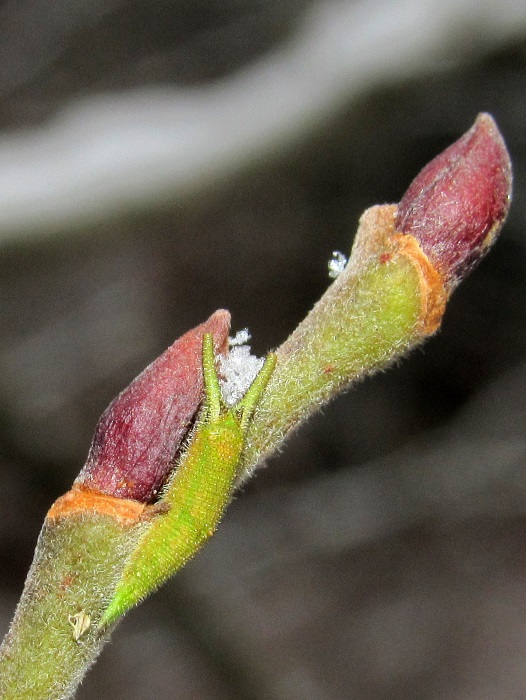
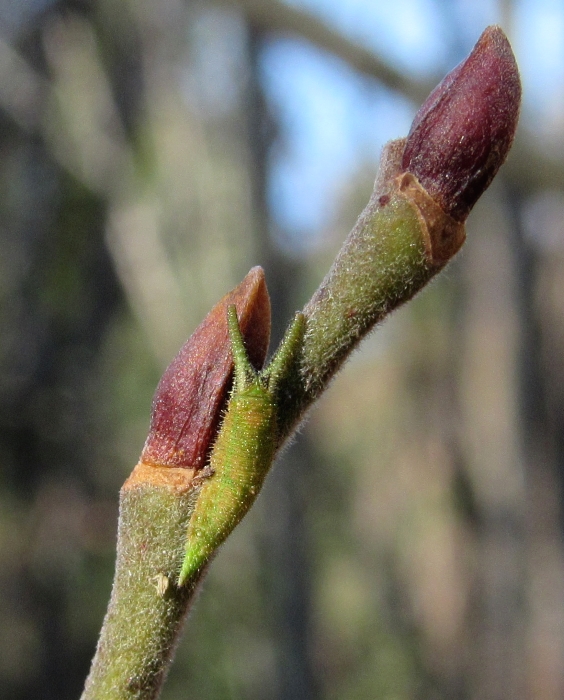
I was sorry to read Matthew's post about wintering larvae in Savernake. As I have been following just one caterpillar this winter it's all or nothing for me, so far as hibernating statistics are concerned. And at the moment, Gautama is still doing fine. These two pictures show him on 12th February and then today, 6th April, just days away from his first meal of 2016:


He first hibernated on a grey branch somewhere (he went completely grey, then wandered off, back in November) and then relocated to this twig at the end of 2015. He has moved less than 1 mm since!

Guy

Monday, March 28, 2016

Late Winter Losses

A very disappointing and worrying end to the winter.  Mortality rates were high during the mid to late autumn period in Savernake Forest, my main study site - i.e. before and shortly after larvae entered diapause.  I don't know why.

Then all was relatively good for a long while, with wild larvae surviving well.  I was cheered to read the BTO announcement that Blue Tit and Great Tit numbers were low this winter, due to poor breeding success last year, as tits are major predators of hibernating Emperor larvae.  However, tit numbers seemed high in Savernake all winter, probably because it was mild enough for them to winter out in the forest (in severe winter weather they seem to desert the forest, presumably to visit gardens).  

The bad news is that Purple Emperor larvae have been hit hard this last month, by assumed (tit) predation.  Also, one wild larva has shrivelled up and died, along with one of my two captive larvae. This is a familiar problem to breeders (I've forgotten what this desiccation is called - can someone please remind me, I've got it written down somewhere...  it's associated with wet weather).  I think I've only recorded three hibernating larvae shrivelling up and dying in the wild, out of some 200 I've followed.  

So, at this stage the prospects for the 2016 Purple Emperor season do not look good...

Thursday, February 25, 2016

Continual Rearing


Below I attach a photo (taken yesterday) of what I believe to be the first, 4th consecutive (i.e. without diapause) generation (in a single season), L2 A.ilia larvae ever produced. In just over 6 weeks time I will have continually cultured these specimens for an entire year without diapause. It would therefore appear that if conditions are optimised it is now possible to continuously rear these species 12 months of the year.


Aside from these new L2 larvae I also currently have a another 20 specimens either in L5, pupae or recently eclosed adults (specimens supplied by Colin Wiskin) which did diapause, but due to the very mild winter conditions woke early and are now producing viable adults.

Much has certainly been learnt about these species in the process.

Monday, February 8, 2016

Surviving Winter

This winter is bloody awful.  It's very similar to that of 2013-14: mild, wet and windy, with gale after wretched gale, although until now (8th Feb) the gales have largely been to the north of the Purple Empire.  

To date, hibernating Purple Emperor larvae have survived reasonably well in the wild.  I haven't got many to follow this winter, but lost one in late November and a second in late January, both to assumed tit predation.  (The second one may have moved, and not been relocated - but it was on a terminal bud, which is a suicidal position as foraging tits search there first and foremost).  

Three larvae have moved after entering hibernation, two during mid-December and another in late January.  Several moved whilst hibernating during the mild winter of 2013-14.

Here's No. 13, Wittgenstein, on the upper side of a fairly thick branch -


Here's No. 14, Kierkegaard, with unusual dark green and yellow mottling - 


And here's No. 9, Heidegger, on an old stem scar -


Wednesday, January 6, 2016

Happy New Year!

A heatwave throughout July and August last year had a notable effect on the emperors. I didn't find a single egg and only in September, when the forest verges were cut, was able to locate any caterpillars - just two, both deep in shade and near the ground, presumably where the air was most humid. I can only hope it was choice of laying site that meant I found no eggs in the usual places. I followed just one caterpillar, Gautama, up to hibernation, when he wandered off. I couldn't find him anywhere. Then suddenly today, on my first Swiss walk of 2016, there he was, not 20cm from the leaf he grew up on.

Gautama:


Happy New Year!

Guy

Monday, January 4, 2016

Sallow in Leaf in Dorset


This could have very bad consequences if colder weather now suddenly appears. Matthew, are any trees in leaf in the relevant forests?


Photo thanks to Andrew Copper (via Facebook)

Friday, January 1, 2016

Up Yours, Titmice!

Delighted to report that all six larvae I've been following in the wild survived December, and were present and correct on Jan 1st (there may be one or two more which I haven't yet located in hibernation).  

This is good news as tit predation tends to be high during mild winter weather, and low during severe cold - but perhaps larvae were protected to some extent by December's excessive rain.  


It appears that tit predation is relatively low in years when larvae are scarce, as is the case now.  

Interesting that two of the six had moved position, one by a staggering 2m.  This tallies with mass movement recorded during the mild December of 2013, when I was following a much larger number of larvae.  However, none of the larvae which woke up and moved during the 2013-14 winter actually survived into the spring.

Here are some photos from today:- 


This one has stayed put, and is close to swelling green buds.

The one above has moved to a shady position up stem, in a lesion, from a terminal leaf bud exposed to sun.  My guess is that it might move again.


There were two here, head to head, but one (No 14, below) moved 2m to a leader bud. 


Interesting that this larva was grey-green but has changed colour to match its new background. 


This one's a cracker, grey on grey.  It's unusual to find one on dead wood. 


Finally, here's one in a classic position.


We are seriously overdue a good summer, and this year is 40 years on from the long hot summer of 1976, the ultimate butterfly summer of modern times.  The last good summer we had was ten years ago, in 2006 - 30 years on from the long hot summer.  So, jack in the job, sell the children into slavery, send the spouse off to the mother-in-law's and go Emperoring - the long hot summer's returning...