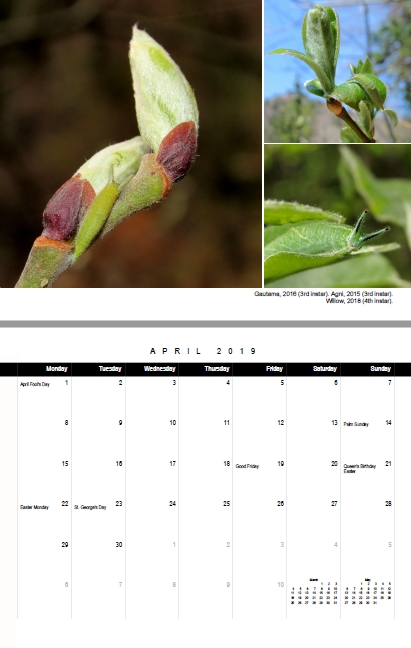
For those with less money and more taste, I've made a 2019 purple emperor hanging wall calendar with photographs taken in the wild in each month. This is April, for example:
All the other months and links to get your own copy can be found here:
Nearly all Emperor larvae have now left the sallow foliage and have wandered off into hibernation. They didn't have much choice as the leaves yellowed and started to fall fast. Most larvae went into hibernation during the second week of November, which is usually peak week. Many have travelled fair distances in this (ridiculously) mild November. I've recorded one travel 2.5m before conking out, and watched another crawl 1m up stem, turn around and go back to within 1cm of where he started, and spin a hibernation foot pad there! Here's No 73 wandering around looking for somewhere to conk out for five long months -
Here's No 62 conked out on the 3rd bud down, known as Suicide Ally (the position with highest tit predation) -
Here's No 20, conked out near a spray tip. Half of his body is on the leaf petiole which will become detached. When that happens he will simply realign himself to the main stem, as larvae hold on primarily by the rear claspers, but it is a daft thing to do -
What we need now is The Beast from the East to return, and drive the tit flocks out of the woods on to bird feeders in the towns. Larvae survival is much higher in cold, frosty, snowy weather. Bring it on!
Tuesday, October 30, 2018
Not a great fan of Halloween, but its a case of you can't beat them, join them. And then beat them!
Purple Emperor larvae are now starting to enter hibernation (or diapause if you prefer). They have been changing colour and journeying off into hibernation somewhat earlier than normal, simply because they are ready. The foliage is also yellowing early, and they are in sync with it. The problem, for me, is that when the weather's warm they travel metres before conking out, rather than centimetres - which means they take ages to locate. Every late October I pray earnestly for miserable cold wet weather, to prevent them from wandering far - and every late October I get a heatwave. I feel like Job. Here are some larvae from last weekend (Savernake and Sussex):-
This one is ready to hibernate, sitting in the curled leaf tip when moisture (fog in this case) gathers. They are often semi-aquatic like this.
This one was making exploratory journeys up-stem, before chickening out and returning to his withered (but silked on at the petiole) leaf.
This one is just starting to change colour, and has spun a massive silk highway all the way up the leaf midrib. I still need to report on my trips to Holland and Catalonia, versus larvae. Holland was terrific: iris is seriously on the march there, colonising Salix cinerea carrs and fens. More anon.
We, The People of Purple Persuasion, are gathering for the People's Walk for Wildlife at the WH Hudson Memorial (Rima carving) in Hyde Park (due west of the main event gathering point at Reformer's Tree) between10.15-10.45 next Saturday morning. https://www.royalparks.org.uk/parks/hyde-park/map-of-hyde-park Nearest tube station is Lancaster Gate. Dress Code: Purple. Condition: Sober (optional) Contact Number: Matthew on 07771 971488.
Hudson was Purple. He saw iris in Newbuildings Woods, W Sussex, just north of Knepp, where I saw my first...
I am a little over half way through my annual standardised search for larvae in Savernake Forest, and have found 61. I should end up with a little over 100. This is the tenth (and perhaps final) year that I've done this. Most years I struggle to find around 25 but I've recorded three years of plenty: 2009, 2013 and, almost certainly, 2018. However, I don't think 2018 will better 2009's or 2013's tally, for several reasons. First, and oddly, the sallows along Grand Avenue are unsuitable this year. This is because the FC resurfaced the Avenue in late winter, using limestone chippings which produce a whirlwind of white dust every time a vehicle speeds by (vehicles have the right to drive along Grand Avenue, and do so at great speed since the speed bumps were removed a few years ago. The dust storms must be visible from space.) All foliage within at least 50m of the Avenue was covered in white dust during the dry July. Secondly, there's a lot of sallow mildew around this autumn. Larvae fail on it, like this (the remains of an L2 larva at the leaf tip) -
Here's a close up of sallow mildew, which develops on overhung sallows. It comes off easily if you run your thumb over it -
Larvae are bang on time, changing from L2 to L3 (an instar which lasts for 8 long months). Here's one from today, it's about to skin change -
Finally, I saw this in Savernake today - a fresh 2nd brood camilla
There could be a sizeable second brood of White Admirals this Sept in southern England... But rest assured, iris is not going to double brood.