Friday, August 30, 2013

Recent Doings

Today I made a brief return to the Wiltshire Wood to check up on Egbert, Blackadder and Baldrick. All are doing well, but only Baldrick was on the same leaf. And Baldrick's no longer "bald" (and therefore technically "Rick") now that he's changed into his second instar and his horns have appeared. I also managed to find one of the other first instar larvae and watched it move off its seat pad to feed on the same leaf, before it returned back to base!
5.jpg
Baldrick
6.jpg
Purple Emperor larva - 1st instar munching away

Sunday, August 25, 2013

2013 Egg Lay

It looks very much as though iris has laid a remarkable number of eggs this year, and has wandered far and wide in the process. 

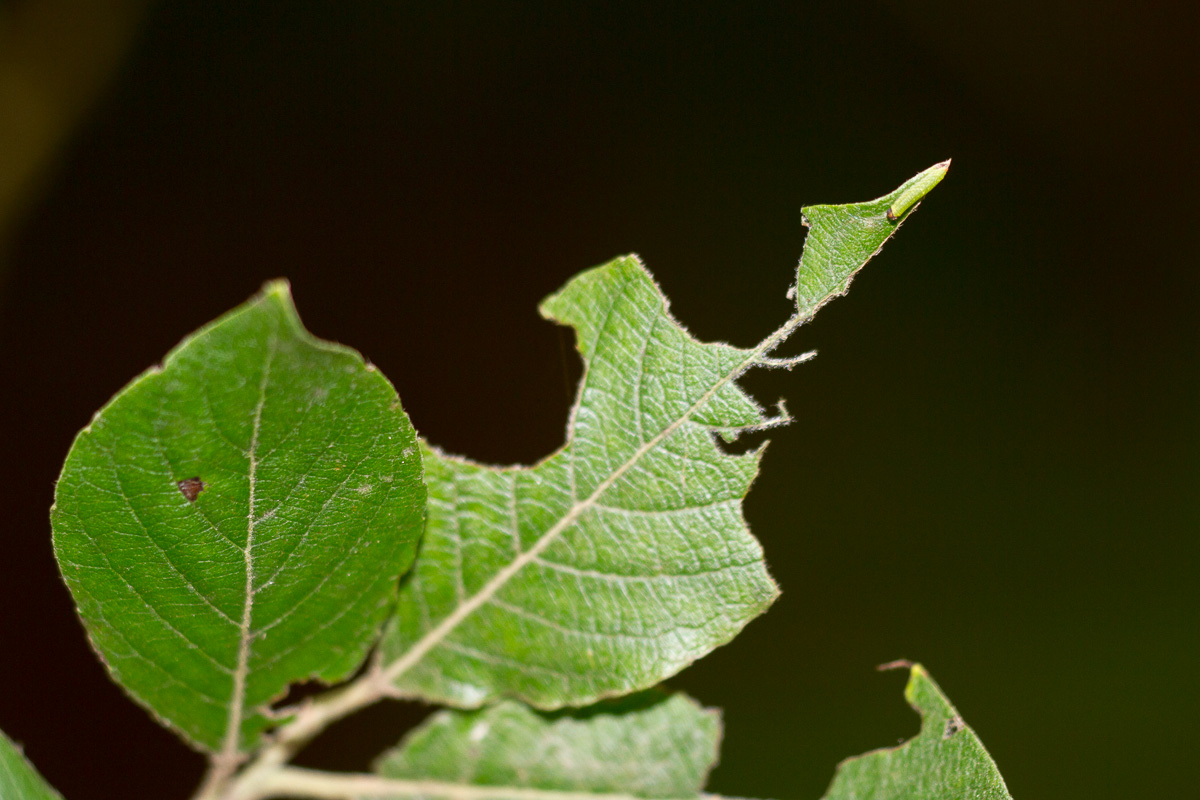
Searching for larvae from early Sept through to late Oct after good egg lay flight seasons is an efficient way of finding new colonies.  The larval damage, around leaf tips, is quite salient.  Concentrate on bushes with mid-green coloured foliage which is soft and matt in texture.  Avoid foliage exposed to mid day sun.

As well as carrying on my monitoring of egg / larval numbers in and around Savernake I'm going to visit some places where the butterfly has not recently been recorded, outside the butterfly's current known range.  I particularly want to declare Swindon, Gloucestershire and Herefordshire Purple...

Today, I'm fairly certain I saw an adult iris, briefly and at a distant, gender uncertain, 20 mins after Pete Eeles left me.  The trouble is that it didn't return, suggesting it wasn't male.  Was it a vision or a waking dream? 

Three in a Row

For the third day in a row I've visited the Wiltshire Wood - this time in the wonderful company of Matthew Oates. What a superb day - definitely one of my "top" butterflying days of the year, despite failing to see a single adult butterfly (immature stages are equally, if not more, fascinating)! Matthew is clearly very experienced in finding the immature stages of iris, and turned up quite a few larvae (and an egg) that I'd completely missed the previous two days - sometimes found based on feeding damage or, believe it or not, the remnants of the egg base! But the highlight was definitely picking up so many tips from Matthew - who explained the importance of tree species, tree position, shade, shelter, leaf size, leaf colour, leaf "thwackiness" (the sound a leaf makes when you flick it), the significance of mildew and so on. I feel a lot more knowledgeable than I did at the start of the day for sure!

After 3 hours of searching, the "stats" are that we found 22 larvae and 1 egg, with an incredible 11 larvae (and the egg) on the same tree. Aside from the egg, approximately half of the larvae found are in their 1st instar, and the others in their 2nd. Matthew also found a larva that had only just changed into its 2nd instar and had yet to devour its old skin (photo below). Given the number of larvae, I've stopped naming them after Blackadder characters with the intention of following them through to adulthood, and will stick with Egbert, Baldrick and Blackadder for the time being! And my thanks to Matthew for being so generous with his time and knowledge.

1.jpg
1st instar larva
2.jpg
2nd instar larva surviving the drizzle
3.jpg
2nd instar larva in its own private water droplet
4.jpg
2nd instar larva
5.jpg
2nd instar larva found on a discoloured leaf that looked totally unsuitable!
6.jpg
Larva that has just changed into its 2nd instar
7.jpg
The master at work!

Saturday, August 24, 2013

Wiltshire Wood - Part 2

This stuff is addictive - as evidenced by others that have succumbed to iris and I can see myself making several trips over the autumn and winter to check up on progress! And my first return visit was today; I just had to go back to see whether or not that egg had hatched and, indeed, it had! And so welcome to the world, Egbert :) (I needed something to remind me that I found him as an egg!). When I found him he had eaten all of his eggshell and had moved to an adjacent leaf and was spinning up a silk pad. By the time I'd left he'd finished and had turned himself around to face the base of the leaf.
Purple Emperor - larva - Wiltshire Wood - 24-Aug-13.jpg
Purple Emperor - larva - Wiltshire Wood - 24-Aug-13-5.jpg
Purple Emperor - larva - Wiltshire Wood - 24-Aug-13-4.jpg
What I didn't realise is that the larvae will sit on the edge of a curled leaf and out of sight - something I hadn't been checking. And so I thought "this must be a good tree since Egbert's mum selected it" and almost immediately found another larva - this time a 2nd instar larva with horns, and clearly the result of a different set of parents given the difference in age. I've christened this chap "Blackadder" for no other reason that I wanted to christen the first larva I found yesterday "Baldrick" since he's missing his "horns" and is therefore "bald". Anyway - something that will help me remember what stage/instar I found these guys in! Almost all Blackadder characters :)
Purple Emperor - larva - Wiltshire Wood - 24-Aug-13-6.jpg

Friday, August 23, 2013

Notes and Views from a Wiltshire Wood

Given the "explosion" of Purple Emperor sightings this year, I figured that this has to be the year to go looking for the immature stages - especially since I've never found them in the wild before. The rationale is that if I can't find them this year, I never will! And so I set off this morning to a Wiltshire wood known for its iris population. After 10 minutes of getting my bearings, I headed off down a forest ride, looking at any sallow that was in full or partial shade, as well as the shaded areas of sallows that were in full sun (which is normally "deep inside" the sallow). I don't know if it's beginner's luck, but the 3rd sallow I searched (Salix caprea) had a 1st instar larva (at least, I think it's 1st instar) sitting on a leaf tip, facing toward the base of the leaf (which showed characteristic feeding damage). After another hour of searching I finally found an egg with the caterpillar fully-formed inside and is probably going to hatch within hours! So - 2 immature stages in 2 hours - not the best of records but not bad for a beginner with this species:)


Wednesday, August 21, 2013

Over in Savernake?

No males seen in favoured territories in Savernake today, and I looked in earnest.  Sunday's male was absent.  Looks like the season may be over there.

BUT, this year's egg lay looks immense.  I've only just started searching for eggs & larvae in Savernake (today was my first proper session) but already, in three hours of actual searching, I have found as many as I found there during the whole of the 2012 larval-hunting season (i.e. some 40 hours of actual searching time).